Light Bulb Base & Socket Size Chart
As an Amazon Associate, we earn from qualifying purchases. Recommendations never depend on commission rates.
Affiliate Disclosure: When you buy through our links, we may earn a commission at no extra cost to you. That supports our specification database and calculators.
Selection Methodology: Picks come from verified manufacturer data sheets, certification databases (DesignLights Consortium QPL for commercial fixtures, California Title 24 JA8, FTC Lighting Facts, and EPA ENERGY STAR for recessed downlights), and owner failure-rate analysis. We do not run hands-on lab tests.
The letter in a bulb base code identifies how the bulb attaches, and the number gives the thread width or pin spacing in millimeters. Use the interactive socket finder and millimeter reference charts below to identify any household or commercial base before ordering an LED replacement.

Interactive Bulb Socket Identifier
Visual Comparison: Screw Bases vs. Pin & Twist Bases
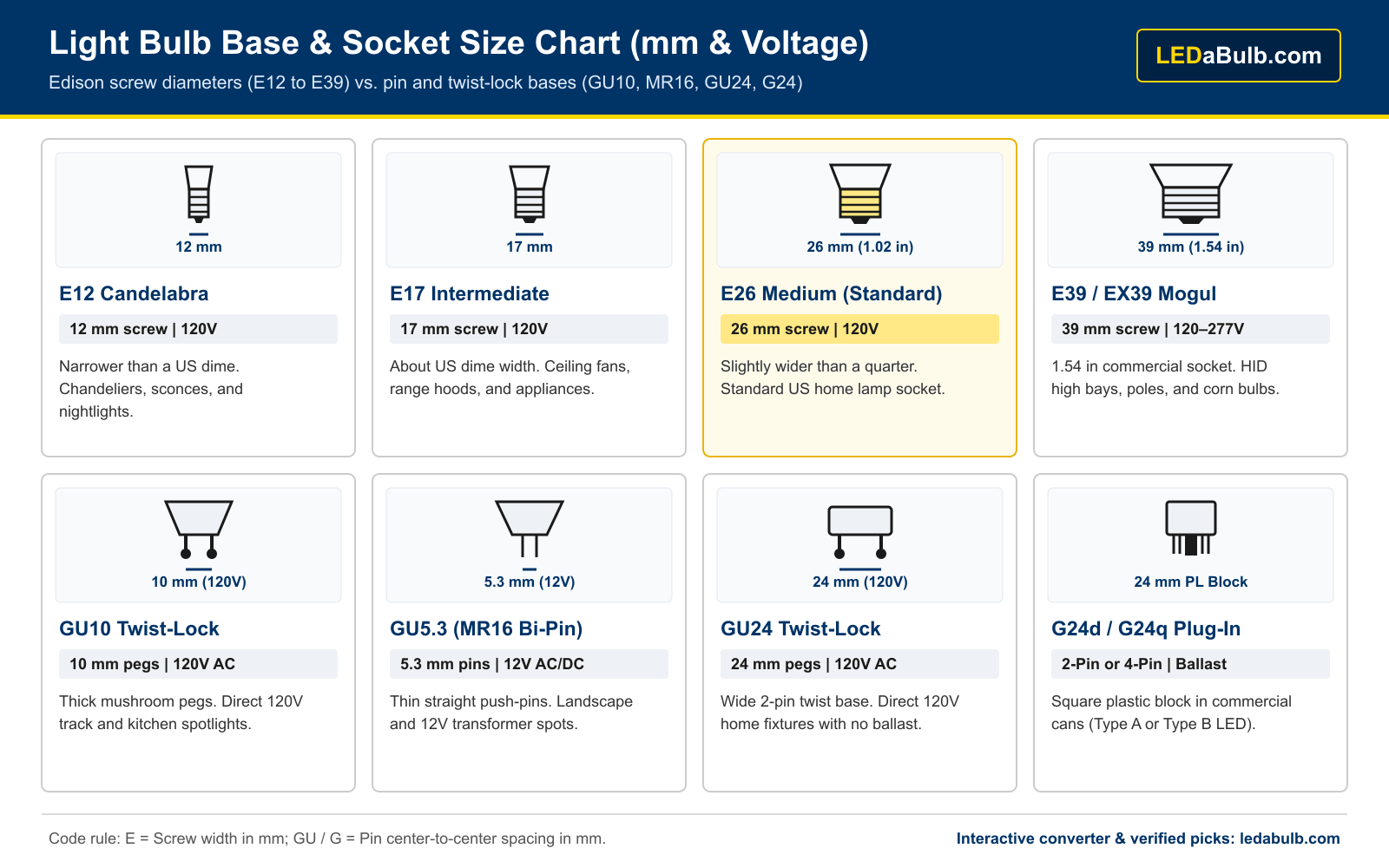
Inspect the bottom contact before ordering. Screw bases scale by outer thread diameter in millimeters, whereas GU and G bases scale by the center-to-center distance between the two pins.
E12 Candelabra
12 mm screw. Narrower than a dime (17.9 mm). Chandeliers and sconces.
E26 Medium
26 mm screw. Slightly wider than a US quarter. Standard 120V home socket.
E39 Mogul
39 mm commercial screw. High-wattage HID poles, wall packs, and corn bulbs.
GU10 Twist-Lock
10 mm spacing with mushroom feet. Line-voltage 120V track and kitchen spots.
GU5.3 (MR16)
5.3 mm straight thin push-pins. Requires a 12V low-voltage transformer.
G9 Loop Bi-Pin
9 mm center-to-center looped wire blades. Line-voltage 120V sconces and pendants.
Edison Screw Base Size Chart (E-Series)
Every Edison screw code starts with E followed by the outer thread diameter in millimeters. Measure straight across the metal threads with a metric ruler or compare the base against a pocket coin when power is off.
| Socket Code | Thread Width | US Coin Match | Common Fixtures & Voltage |
|---|---|---|---|
| E10 Miniature | 10 mm (0.39 in) | Much smaller than a dime | 1.5V–12V DC flashlights, vintage indicator lamps, model trains |
| E11 Mini-Candelabra | 11 mm (0.43 in) | Smaller than a dime | 120V halogen cabinet spots, crystal chandeliers |
| E12 Candelabra | 12 mm (0.47 in) | 2/3 width of a dime (17.9 mm) | 120V dining chandeliers, sconces, C7 holiday strings, nightlights |
| E14 Small Edison | 14 mm (0.55 in) | Smaller than a dime | 220V–240V European & UK chandeliers and imported lamps |
| E17 Intermediate | 17 mm (0.67 in) | Matches a US dime (17.9 mm) | 120V ceiling fan light kits, range hoods, 15W appliances, C9 strings |
| E26 US Standard | 26 mm (1.02 in) | Slightly wider than a quarter | 120V US table lamps, ceiling domes, A19, BR30, PAR38 |
| E27 EU Medium | 27 mm (1.06 in) | Wider than a US quarter | 220V–240V international sockets (do not mix voltages) |
| E39 / EX39 Mogul | 39 mm (1.54 in) | Wider than a silver dollar | 120V–277V+ metal halide & HPS poles, high bays, corn bulbs |
Pin, Twist-Lock & Double-Ended Base Chart (G, GU, R7s, Bayonet)
Pin bases use G (originally standing for glass-insulated pins) and U (mechanical retention clip or twist-lock groove). The number gives exact center-to-center pin spacing in millimeters.
| Socket Code | Pin Spacing | Voltage | Common Fixtures & Retrofit Guide |
|---|---|---|---|
| G4 2 thin straight pins | 4.0 mm | 12V AC / DC | RV/marine lights, under-cabinet pucks, landscape (20W halogen) |
| GU5.3 (MR16) 2 straight push-pins | 5.3 mm | 12V AC / DC | Low-voltage track heads, landscape spots, display cases (35W halogen) |
| GY6.35 2 thicker straight pins | 6.35 mm | 12V or 24V | Task desk lamps, pendants, display cabinets |
| G9 2 looped wire blades | 9.0 mm | 120V AC | Modern glass globe sconces, bathroom vanity bars, dining pendants |
| GU10 2 mushroom twist lugs | 10.0 mm | 120V AC | Line-voltage track lighting, range hoods (50W halogen, spotlights) |
| GU24 2 wide twist-lock lugs | 24.0 mm | 120V AC | Title 24 energy-code ceiling mounts, porch lanterns, bath sconces |
| GX53 Shallow disc twist lugs | 53.0 mm | 120V AC | Slim surface-mount under-cabinet and closet puck lights |
| R7s (J-Type) Recessed end contacts | 78 or 118 mm | 120V AC | 300W torchieres & 500W work floods (full fixture swap advised) |
| BA15s / BA15d 15 mm bayonet twist | Single / dual contact | 12V or 120V | Sewing machines, RVs, boats, landscape step fixtures (check voltage stamp) |
Linear Tube & Commercial Plug-In CFL Base Chart
Fluorescent tubes and commercial architectural downlights connect through tombstones or keyed 2-pin and 4-pin ballast sockets rather than screw threads.
| Socket Code | Pin Spacing | Lamp Family | LED Retrofit Notes |
|---|---|---|---|
| G13 Medium bi-pin | 13.0 mm | 4-ft T8 & T12 tubes | T8 and T12 share identical G13 pins; check shunted vs non-shunted tombstones for Type B |
| G5 Miniature bi-pin | 5.0 mm | T5 & T5HO tubes | Smaller pins and ~45.8-inch tube length; incompatible with G13 T8 fixtures |
| FA8 Single pin | 1 pin per end | 8-foot slimline T8 / T12 | Spring-loaded tombstone; commonly rewired to Type B 8-ft LED tubes |
| R17d (HO) Recessed double contact | Oval plastic cap | 8-foot High Output T12HO | Bypass magnetic ballast and install R17d Type B LED tube or linear strip |
| G23 / GX23 2-pin w/ starter | Keyed plastic tab | 5W to 13W twin-tube CFL | Contains internal starter for magnetic ballast; use Type B bypass LED PL or new sconce |
| G24d-1/2/3 2-pin commercial PL | 24 mm center block | 18W to 26W CFL cans | Driven by magnetic ballast; bypass ballast for Type B G24 LED or install 6-inch LED downlight |
| G24q / GX24q 4-pin commercial PL | 4 pins around block | 26W to 42W CFL cans | Driven by electronic ballast; use Type A plug-in or Type B direct-wire LED PL |
Critical Compatibility Warnings: E26 vs. E27 and GU10 vs. GU5.3
Two pairs of bases cause 90% of wrong-socket returns and damaged LED drivers because they look nearly identical in online photos.
E26 vs. E27: Thread Fit Does Not Mean Voltage Fit
E26 (26 mm) is the 120V 60Hz standard in the United States and Canada, while E27 (27 mm) is the 220V to 240V 50Hz standard in Europe, the UK, Asia, and Australia. Because their thread pitches differ by only 1 millimeter, an E26 bulb often threads loosely into an E27 socket. Never install a 120V-only North American E26 LED bulb into a 230V E27 circuit, or the internal driver capacitor will fail immediately; conversely, a 230V-only E27 bulb placed in a 120V US lamp will run dim, flicker, or fail to turn on unless its stem explicitly prints 100-240V.
GU10 vs. GU5.3 (MR16): 120V Line Voltage vs. 12V Transformer
Both 2-inch reflector spotlights fit small track heads and 4-inch recessed trims, yet their electrical inputs are completely different. GU10 has two thick cylindrical posts with wider mushroom-shaped feet spaced 10 mm apart that push in and twist a quarter turn on 120V household line power. GU5.3 has two thin, straight needle-like pins spaced 5.3 mm apart that push straight into a 12V low-voltage transformer socket. If a new 12V GU5.3 LED bulb flickers or strobes, the old halogen electronic transformer requires a higher minimum wattage load; see our LED flicker and transformer compatibility guide.
EX39 vs. E39 Mogul Sockets in Commercial Fixtures
Open-rated pulse-start metal halide fixtures use a shrouded EX39 ("exclusionary") socket with a slightly longer center contact pin so older unshrouded E39 lamps cannot make electrical contact. When buying a Type B LED corn bulb for an existing commercial housing, verify whether the LED stem lists E39/EX39 universal compatibility.
Are Socket Reducers and Base Adapters Safe?
Passive screw-in socket adapters (such as GU24-to-E26 or E12-to-E26) only change the physical shape of the contact and never convert voltage. Follow three safety rules whenever using an adapter:
- Only adapt matching voltages: Using a UL-listed GU24-to-E26 or E39-to-E26 reducer on a 120V circuit is electrically valid (provided you bypassed any HID ballast first), whereas adapting a 12V socket to a 120V socket will not power the bulb correctly.
- Check mechanical torque and shade clearance: Enlarging an E12 chandelier socket to E26 adds 1 inch of height and puts heavy bending stress on delicate brass candle sleeves. Buy native E12 LED candelabra bulbs instead of stacking heavy A19 bulbs on E12-to-E26 adapters.
- Never exceed socket wattage or enclosed-heat limits: Keep LED draw well below the fixture's maximum wattage sticker, and pair this chart with our light bulb shape and size chart to verify glass envelope clearance.
Frequently Asked Questions
Is an A19 bulb the same thing as an E26 base?
No. A19 describes the pear-shaped glass top (2.375 inches wide), while E26 describes the 26-millimeter metal screw base at the bottom. Most household A19 bulbs sold in North America have an E26 base, which is why shoppers often treat the two codes as interchangeable, though A19 bulbs are also made with GU24 twist-lock bases.
How can I tell E12 from E17 without calipers?
Turn off power, remove the bulb, and hold a US dime (17.9 mm wide) next to the screw threads. An E17 intermediate base (17 mm) is nearly the exact same width as a dime, whereas an E12 candelabra base (12 mm) is noticeably narrower, about two-thirds of a dime.
Can I put an E26 household LED bulb into a 70W HPS or metal halide E26 socket?
Never screw a standard 120V household E26 LED bulb into an active HID wall pack or yard light without bypassing the ballast and ignitor first. HID ignitors fire multi-kilovolt starting pulses that destroy household LED electronics immediately.
What is the difference between 2-pin G24d and 4-pin G24q CFL bases?
2-pin G24d plug-in lamps contain an internal starter designed for older magnetic ballasts, while 4-pin G24q and GX24q lamps omit the internal starter and run on electronic dimming or non-dimming ballasts. Always count the pins before buying a Type A plug-in LED replacement, or bypass the ballast completely with a universal Type B LED retrofit.
Do T8 and T12 fluorescent tubes use the same socket?
Yes. Both 1-inch T8 tubes and 1.5-inch T12 tubes use the exact same G13 medium bi-pin base with 13-millimeter pin spacing, so a 4-foot Type B T8 LED tube physically fits into an older 4-foot T12 shop light once you bypass the magnetic ballast. Smaller 5/8-inch T5 tubes use miniature G5 sockets and are not interchangeable.