Halogen to LED Conversion Chart (20W to 500W)
As an Amazon Associate, we earn from qualifying purchases. Recommendations never depend on commission rates.
Affiliate Disclosure: When you buy through our links, we may earn a commission at no extra cost to you. That supports our specification database and calculators.
Selection Methodology: Picks come from verified manufacturer data sheets, certification databases (DesignLights Consortium QPL for commercial fixtures, California Title 24 JA8, FTC Lighting Facts, and EPA ENERGY STAR for recessed downlights), and owner failure-rate analysis. We do not run hands-on lab tests.
A halogen bulb uses 5 to 7 times more electricity than an LED of equal brightness and runs above 500°F. Match your replacement by lumen output, system voltage (12V vs. 120V), and pin or screw base.
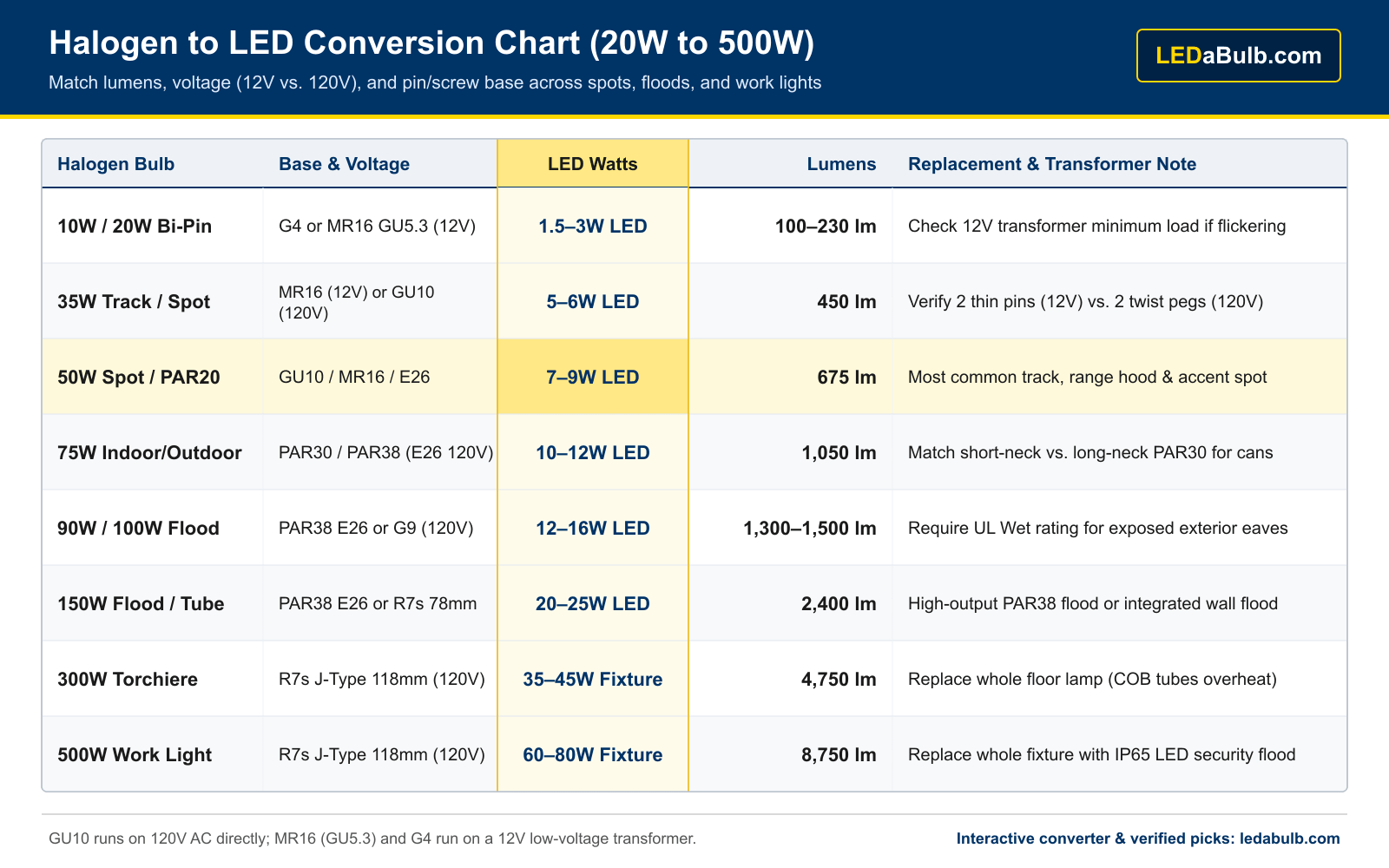
Halogen to LED Wattage & Lumen Chart
Halogen bulbs produce roughly 12 to 20 lumens per watt, slightly higher than standard incandescents. Use the lumen column below to select an LED with matching directional light output, and check annual electricity savings at $0.18/kWh (3 hours per day).
| Halogen Bulb | LED Watts | Lumens | Savings / Yr | Guide |
|---|---|---|---|---|
| 10W G4 bi-pin (12V) | 1–1.5W | 100 lm | $1.74 | Calculate |
| 20W MR16 GU5.3 / G4 (12V) | 3W | 230 lm | $3.35 | View 20W |
| 35W MR16 GU5.3 / GU10 | 5–6W | 450 lm | $5.81 | View 35W |
| 50W GU10 / MR16 / PAR20 | 7–9W | 675 lm | $8.28 | View 50W |
| 65W BR30 / PAR30 flood | 9–11W | 850 lm | $10.84 | Calculate |
| 75W PAR30 / PAR38 E26 | 10–12W | 1,050 lm | $12.61 | View 75W |
| 90W PAR38 E26 flood | 12–15W | 1,300 lm | $15.08 | Calculate |
| 100W PAR38 E26 / T4 G9 | 13–16W | 1,500 lm | $16.85 | View 100W |
| 150W PAR38 / J-type 78mm | 20–25W | 2,400 lm | $25.13 | View 150W |
| 300W R7s 118mm torchiere | 35–45W (fixture) | 4,750 lm | $51.25 | View 300W |
| 500W R7s 118mm work flood | 60–80W (fixture) | 8,750 lm | $84.75 | View 500W |
Annual savings calculated at 3 hours/day, 365 days/year, $0.18/kWh US residential average.
Check Voltage & Base Before Buying (12V vs. 120V)
Halogen track, landscape, and recessed bulbs look almost identical from the front, yet use incompatible voltages and pin bases. Pull one old halogen bulb and read the stamp on its neck before ordering LEDs.
| Base Code | Pin / Screw Shape | Voltage | LED Upgrade Rule |
|---|---|---|---|
| GU10 | 2 thick twist-lock pegs (10mm apart) | 120V AC | Direct swap. No low-voltage transformer in the ceiling. See GU10 spotlight picks. |
| MR16 (GU5.3) | 2 thin straight push-pins (5.3mm apart) | 12V AC/DC | Runs on a hidden 12V transformer. Old magnetic or electronic halogen transformers often require a 20W minimum load; if LEDs flicker or refuse to start, install an LED-rated 12V driver. |
| G4 / GY6.35 | 2 tiny wire pins (4mm or 6.35mm apart) | 12V AC/DC | Measure physical capsule length carefully. Many under-cabinet puck housings require flat disc-style G4 LED wafers so the glass lens still closes. |
| G9 | 2 looped wire pins (9mm apart) | 120V AC | Used in decorative sconces and chandeliers. Choose silicone-encapsulated or ceramic G9 LEDs rated for enclosed glass shades, and verify physical diameter. |
| E26 (PAR20 / PAR30 / PAR38) | Standard 26mm household screw base | 120V AC | Direct screw-in replacement. Match the PAR number (PAR20 = 2.5 in, PAR30 = 3.75 in, PAR38 = 4.75 in) and choose UL Wet Rated for exposed outdoor eaves. |
| R7s (J-Type 78mm / 118mm) | Double-ended linear quartz tube | 120V AC | Avoid thick R7s retrofit LED cylinders: most will not fit past the reflector clip and overheat inside narrow halogen housings. Replace the whole floodlight or torchiere with an integrated LED fixture. |

Why 300W and 500W R7s Halogen Fixtures Should Be Replaced Whole
Linear 300W and 500W R7s quartz halogen tubes produce 4,750 to 8,750 lumens from a pencil-thin glass tube less than half an inch wide. An LED needs aluminum heat sinks and driver circuitry that cannot fit inside that tiny R7s footprint.
- Retrofit R7s bulbs under-deliver: Most plug-in R7s LED tubes max out at 1,000 to 1,800 lumens (roughly a 75W–100W halogen) and fail early from trapped heat inside sealed floodlight glass.
- Outdoor 300W–500W work/security floods: Replace the entire halogen head with a hardwired IP65 LED security floodlight (3,000–7,000 lumens). See our Outdoor LED Floodlight Guide.
- Indoor 300W halogen torchiere floor lamps: Replace the lamp with an integrated LED torchiere or high-CRI reading floor lamp. You eliminate a serious 900°F curtain fire hazard and save over $50 per year. See our Reading & Floor Lamps Guide.
Halogen vs. LED: Dimming, Color & Heat
- Color temperature match: Standard halogen capsules run at 2900K–3000K, slightly crisper and whiter than 2700K incandescent bulbs. Choose 3000K CRI 90+ LEDs to preserve the crisp halogen look on countertops, tile, and artwork.
- Dimmer switch compatibility: Older rotary and slide dimmers built for 150W–600W halogen loads often drop below their minimum wattage threshold when you swap six 50W halogens (300W) for six 7W LEDs (42W). Upgrading the wall switch to a Lutron Diva LED+ or ELV dimmer stops low-end shimmer and buzzing.
- Appliance & oven warning: Never put an LED bulb inside a kitchen oven, microwave cavity, or high-heat warming lamp. LED drivers fail above 185°F (85°C); keep a high-temp rated halogen or appliance incandescent for inside-oven sockets.
Frequently Asked Questions
Can I put an LED bulb directly into a halogen socket?
Yes, for 120V sockets such as E26 screw bases, GU10 twist-lock bases, and G9 bi-pin sockets, provided the bulb physically fits the shade. For 12V sockets (MR16 GU5.3 and G4), the socket matches, but you may need an LED-compatible 12V driver if your old halogen transformer flickers under the lower wattage load.
What Kelvin matches a halogen light bulb?
Choose 3000K (Warm/Bright White) with CRI 90+. Standard household incandescents sit near 2700K, while quartz halogen bulbs burn hotter and cleaner at 2900K to 3000K with CRI 100.
Why do my new MR16 LED bulbs flicker or shut off after a few seconds?
Your ceiling or track fixture contains a 12V electronic halogen transformer with a minimum load requirement (commonly 20W to 35W). Three 5W MR16 LEDs draw only 15W total, causing the transformer to drop out. Swapping the transformer for a zero-minimum-load 12V LED driver solves the problem permanently.