Metal Halide to LED Conversion Chart & Replacement Guide
As an Amazon Associate, we earn from qualifying purchases. Recommendations never depend on commission rates.
Affiliate Disclosure: When you buy through our links, we may earn a commission at no extra cost to you. That supports our specification database and calculators.
Selection Methodology: Picks come from verified manufacturer data sheets, certification databases (DesignLights Consortium QPL for commercial fixtures, California Title 24 JA8, FTC Lighting Facts, and EPA ENERGY STAR for recessed downlights), and owner failure-rate analysis. We do not run hands-on lab tests.
A 400W metal halide fixture actually pulls 455W at the breaker once ballast heat is counted, loses 30% to 40% of its brightness within the first year, and stays dark for 10 to 15 minutes after a power dip. Matching an LED replacement to maintained lumens cuts commercial lighting load by 60% to 67% with instant restrike.
- Fast Wattage Match: 70W MH (90W w/ ballast) → 25–35W LED (4,000 lm) · 175W MH (210W) → 60–80W LED (10,500 lm) · 250W MH (290W) → 90–120W LED (14,500 lm) · 400W MH (455W) → 130–180W LED (23,500 lm) · 1000W MH (1,090W) → 300–450W LED (55,000 lm).
- Warehouse & Shop High Bays (175W–400W+ MH): Hang a new Hyperlite Hero 150W UFO High Bay or Lithonia CPHB Compact Pro High Bay instead of putting a corn bulb inside an old reflector dome.
- Outdoor Wall Packs & Pole Lights: Swap yellowed building wall packs to a RAB Full-Cutoff LED Wall Pack and parking lot poles to a Lithonia 150W DLC Shoebox.
- Post-Tops, Bollards & Clean Canopies: Keep the housing and wire line voltage straight to the socket (Type B ballast bypass) with a Luxrite E39 Mogul LED Corn Bulb.
Quick Metal Halide Replacement & Facility Payback Finder
Select your existing metal halide lamp wattage and fixture style to get the exact LED replacement wattage, maintained lumen target, socket rule, and annual electricity savings.
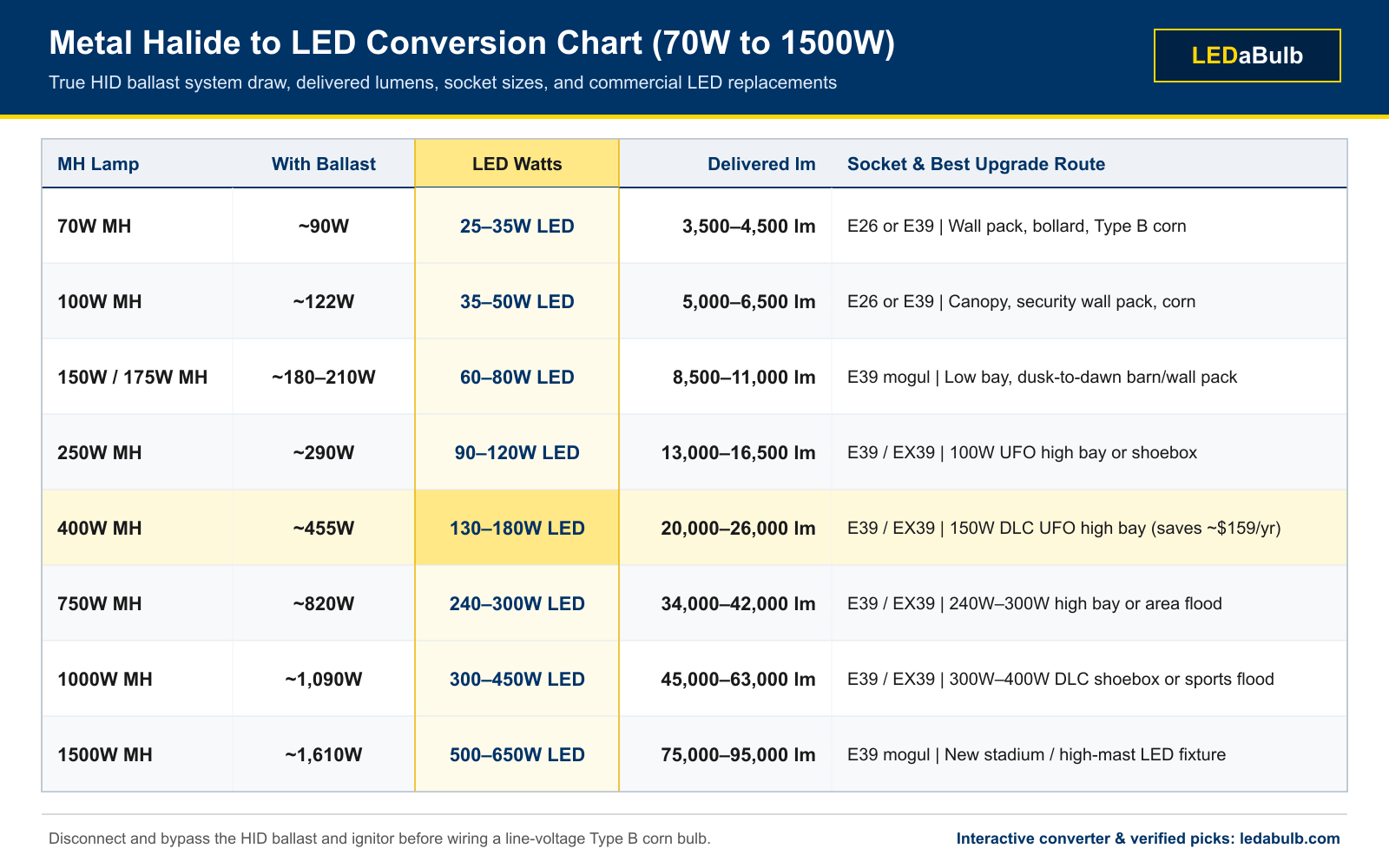
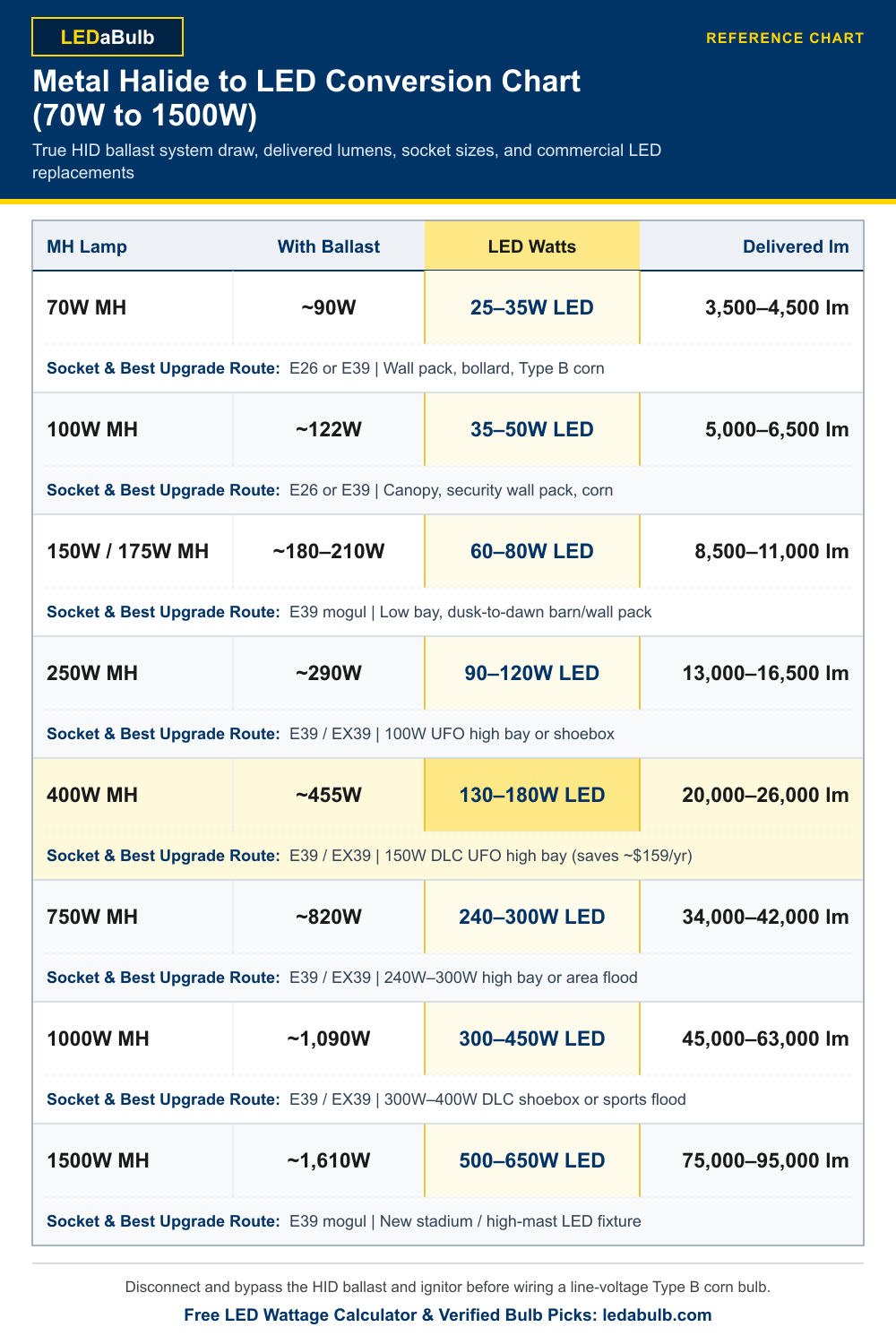
Metal Halide to LED Conversion Chart (70W to 1500W)
Metal halide ballasts draw 10% to 28% extra power as heat. The table below compares true system draw at the wall against maintained directional LED output. Select View ROI for ANSI ballast codes and wiring steps or Find Bulb for vetted replacements.
| Metal Halide (w/ Ballast) | LED Replacement | Maintained Lumens | Power Cut | Action |
|---|---|---|---|---|
| 70W MH (90W sys · E26 / G12) | 25–35W LED | 4,000 lm | ~67% | |
| 100W MH (122W sys · E26 / E39) | 35–50W LED | 6,000 lm | ~65% | |
| 150W MH (180W sys · E26 / E39) | 60–80W LED | 9,750 lm | ~61% | |
| 175W MH (210W sys · E39 Mogul) | 60–80W LED | 10,500 lm | ~67% | |
| 250W MH (290W sys · E39 Mogul) | 90–120W LED | 14,500 lm | ~64% | |
| 400W MH (455W sys · E39 / EX39) | 130–180W LED | 23,500 lm | ~66% | |
| 750W MH (820W sys · E39 Mogul) | 240–320W LED | 38,000–45,000 lm | ~65% | |
| 1000W MH (1,090W sys · E39 Mogul) | 300–450W LED | 55,000 lm | ~66% | |
| 1500W MH (1,610W sys · Sports Flood) | 500–650W LED | 75,000–90,000 lm | ~64% |

Best Metal Halide LED Replacements by Fixture Type
Choose a replacement by your fixture job rather than forcing a screw-in bulb into every housing. For 250W and 400W+ indoor bays or pole lights, a complete DLC-listed LED fixture costs nearly the same as a giant corn bulb, runs cooler, and qualifies for utility rebates.
1. Indoor Warehouse & Shop High Bays (Replaces 175W–400W MH)

Hyperlite Hero Series UFO LED High Bay, 150W (400W MH Replacement)
Top value replacement for 400W metal halide warehouse and shop high bays hung 15 to 28 feet high. Delivers 21,750 directional lumens from 150W, cutting wall draw by 67% vs. a 455W ballasted MH fixture, and includes a hanging hook plus a 5 ft 120V cord.
Honest Limitation: Too bright below 14-foot ceilings; step down to the 100W model (14,000 lm) when replacing 175W or 250W metal halide fixtures in lower bays.
Check Price on Amazon → Premium / Pro
Lithonia Lighting CPHB Compact Pro LED High Bay (250W-400W MH Replacement)
Industrial die-cast aluminum high bay built for manufacturing bays, gyms, and distribution centers running 120-277V commercial panels. Handles high overhead heat, supports 0-10V dimming, and qualifies for DLC utility rebates.
Honest Limitation: Hardwire-only installation with no factory 120V plug attached; select the 24,000-lumen CPHB tier for ceilings above 22 feet.
Check Price on Amazon →2. Type B Ballast-Bypass Corn Bulbs (Post-Tops, Bollards & Clean Canopies)
Luxrite 150W Type B E39 Mogul LED Corn Bulb, 5000K (400W MH Eq.)
Best screw-in retrofit when keeping an architectural post-top acorn, bollard, or enclosed canopy housing in clean condition. Wires straight to 100-277V line voltage after bypassing the ballast and includes built-in surge protection.
Honest Limitation: Requires an electrician to bypass the existing HID ballast and ignitor (Type B). Measure internal cage clearance first, and confirm whether pink shrouded EX39 sockets need an EX39-rated base.
Check Price on Amazon → Economy 175W-250W Retrofit
Sunco 80W Type B E39 Mogul LED Corn Bulb, 5000K (175W-250W MH Eq.)
Low-cost ballast-bypass lamp for 175W and 250W metal halide canopy lights, parking garages, and security housings. Drops system power from 210-290W down to 80W with instant restrike after voltage dips.
Honest Limitation: 360-degree corn lamps bounce up to half their light off the old fixture reflector; if your reflector is yellowed or pitted, hang a new LED fixture instead.
Check Price on Amazon →3. Outdoor Building Wall Packs & Parking Lot Shoeboxes

RAB Lighting Field-Adjustable Full-Cutoff LED Wall Pack (70W-250W MH Eq.)
Replaces yellowed glass-front 70W, 100W, 150W, and 175W E26 or E39 metal halide building wall packs. Zero-uplight optics put light on doors and loading docks without neighbor glare, with onboard wattage and Kelvin switches.
Honest Limitation: Full-cutoff optics aim strictly downward along walls and walkways; use a pole-mounted shoebox fixture to reach across wide parking lots.
Check Price on Amazon → Best Pole Shoebox
Lithonia Lighting 150W DLC LED Shoebox Area Light with Photocell (400W MH Eq.)
Purpose-built pole fixture for 400W metal halide parking lots and commercial drives. Type III roadway optics spread 21,000 lumens evenly across asphalt without the 30-35% trapped-light loss of putting a corn bulb inside an old HID box.
Honest Limitation: Verify whether your existing pole uses a square arm, round pole, or slipfitter tenon so you order the matching mounting bracket.
Check Price on Amazon →Screw-In Corn Bulb vs. New Integrated LED Fixture: Which Should You Buy?
Facility buyers lose money when they put high-wattage corn bulbs inside sealed, yellowed 20-year-old housings where internal heat cooks the LED driver in two years. Use this comparison to pick the right path before ordering:
| Factor | Type B LED Corn Bulb (Keep Housing) | New Integrated LED Fixture |
|---|---|---|
| Best Use Cases | Decorative acorn post-tops, bollards, architectural sconces, clean recessed canopies (70W–250W MH) | Warehouse high bays, parking lot poles, yellowed glass wall packs, sports floods (175W–1500W MH) |
| Optical Efficiency | 360-degree output; loses 20%–35% bouncing off aged reflectors or yellowed polycarbonate lenses | 100% directional forward optics (Type III roadway or 90°/120° bay beam) with zero reflector trap loss |
| Heat Dissipation | Trapped inside existing sealed glass globe; many 100W+ corn bulbs rely on tiny internal cooling fans | Finned die-cast aluminum body sheds heat directly into open air for 50,000–100,000 hr driver life |
| Hardware Cost | $25–$95 per lamp | $65–$260 per luminaire |
| Electrician Labor | 15–25 min per fixture to open housing, disconnect ballast/ignitor/capacitor, and wire socket to line | 15–30 min per fixture to unhook old high bay or wall pack and hang new unit (faster than gutting rusty ballasts) |
| Utility Rebates | Select DLC-listed mogul lamps qualify ($15–$40/lamp) | Highest rebate tier via DLC 5.1 Standard/Premium ($35–$125+ per fixture; check DSIRE first) |
How Metal Halide Ballast Bypass (Type B) Works
Commercial metal halide retrofits almost always use Type B direct-wire wiring rather than Type A plug-and-play bulbs. Removing the old magnetic or pulse-start ballast (`M57`, `M58`, `M59`, `M135`, `M155`) solves three problems at once:
- Eliminates 14% to 28% ballast heat loss: An aged 400W probe-start ballast burns 55W continuously even as the lamp dims. Bypassing it cuts meter draw immediately.
- Prevents ignitor voltage spikes: Pulse-start MH ballasts fire a 3,000V to 4,000V starting pulse to strike an arc tube. Leaving an ignitor connected will destroy an unprotected LED lamp instantly.
- Accepts 100–277V universal commercial voltage: Type B corn bulbs and commercial LED fixtures run directly on 120V, 208V, 240V, or 277V circuits without swapping transformer taps. Only 480V 3-phase industrial ceilings require a 480V-rated high bay driver or step-down transformer.
For commercial warehouses, parking lots, and pole lights, hire a licensed electrician to isolate the breaker, disconnect the ballast, capacitor, and ignitor, wire hot and neutral straight to the porcelain mogul socket (or new fixture whip), and apply the included UL retrofit warning sticker inside the housing so nobody screws a metal halide bulb back into a line-voltage socket later.
Frequently Asked Questions
Why does a 23,500-lumen LED look brighter than a 36,000-lumen 400W Metal Halide?
A 400W metal halide bulb only produces 36,000 lumens on Day 1 in all directions. Within 6 to 12 months it drops to roughly 23,500 mean lumens, and another 25% to 35% of that light gets trapped bouncing inside the fixture hood. A 150W LED high bay aims all 21,750 to 23,500 lumens straight toward the floor and holds over 90% of that output for years.
Can I screw an LED corn bulb straight into a Metal Halide socket without touching the ballast?
Only if the LED box explicitly says Type A HID Ballast Compatible and lists your exact ANSI ballast code (such as M59 or M155). In practice, Type A HID bulbs still waste 15% of power in the old ballast and go dark when that aging ballast fails. Commercial electricians almost always wire Type B ballast-bypass or hang a new LED fixture.
What is the difference between an E39 and an EX39 mogul socket?
Both have the same 39mm thread width, but an EX39 (exclusionary mogul, usually pink porcelain) has a raised shroud around the center contact used on open-rated MH fixtures so standard probe-start lamps cannot make contact. An EX39 bulb fits both E39 and EX39 sockets, whereas a short-tip E39 bulb will not reach the contact inside a pink EX39 socket.
Should I choose 4000K or 5000K when replacing Metal Halide?
Choose 4000K Neutral White to match the natural white appearance of fresh quartz metal halide lamps while minimizing harsh night glare on outdoor walls and lots. Choose 5000K Daylight for high-ceiling inspection bays, machine shops, and security yards where high visual contrast matters most.
What if my warehouse high bays run on 277V or 480V power?
Nearly all commercial LED high bays, shoeboxes, and Type B mogul corn bulbs accept 100–277V automatically with no tap changes. If your facility runs 347V or 480V lighting circuits, do not install a standard 100–277V unit; order a dedicated 277–480V high-voltage LED high bay or Lithonia/RAB industrial driver configuration.