CFL to LED Conversion Chart: Spiral, GU24 & Pin-Base PL Guide
As an Amazon Associate, we earn from qualifying purchases. Recommendations never depend on commission rates.
Affiliate Disclosure: When you buy through our links, we may earn a commission at no extra cost to you. That supports our specification database and calculators.
Selection Methodology: Picks come from verified manufacturer data sheets, certification databases (DesignLights Consortium QPL for commercial fixtures, California Title 24 JA8, FTC Lighting Facts, and EPA ENERGY STAR for recessed downlights), and owner failure-rate analysis. We do not run hands-on lab tests.
Compact fluorescent lamps (CFLs) take 15 to 60 seconds to reach full brightness, contain 1 to 5 mg of mercury vapor, and burn 35% to 45% more power than modern LEDs. Look at the plastic collar on your old CFL first: screw-in spirals and GU24 twist-lock bulbs swap in 10 seconds, while 2-pin and 4-pin G24 plug-in tubes sit behind a fixture ballast.
- Screw-In Spiral CFLs (E26): 9W CFL (=40W bulb, 450 lm) → 5–6W LED · 13–15W CFL (=60W bulb, 800 lm) → 8–9W LED (GE Relax HD A19) · 18–20W CFL (=75W, 1,100 lm) → 10–12W LED · 23–25W CFL (=100W, 1,600 lm) → 14–16W LED (Philips 100W-Eq A19).
- 2-Pin Stubby Twist-Lock (GU24): Runs on 120V line power with no ballast. Twist in a Sunco GU24 9W LED directly.
- 2-Pin (G23 / G24d) & 4-Pin (G24q / GX24q) Plug-In PL Tubes (13W–42W): Use a Feit 4-Pin Type A Plug-and-Play LED if your electronic ballast still works, or bypass the ballast permanently with a Sunco Type B G24 LED.
- Recessed Ceiling Cans: Replace slow-warming R30/BR30 spiral floods or yellowed 6-inch PL cans cleanly with a Halo RL560 5/6-Inch LED Retrofit Trim.
Quick CFL Socket, Ballast & Lumen Matcher
Check the wattage stamped on your old CFL's plastic base and select what the bottom connector looks like to verify whether your fixture has a hidden ballast before ordering.
CFL to LED Conversion Chart (With Incandescent Equivalents)
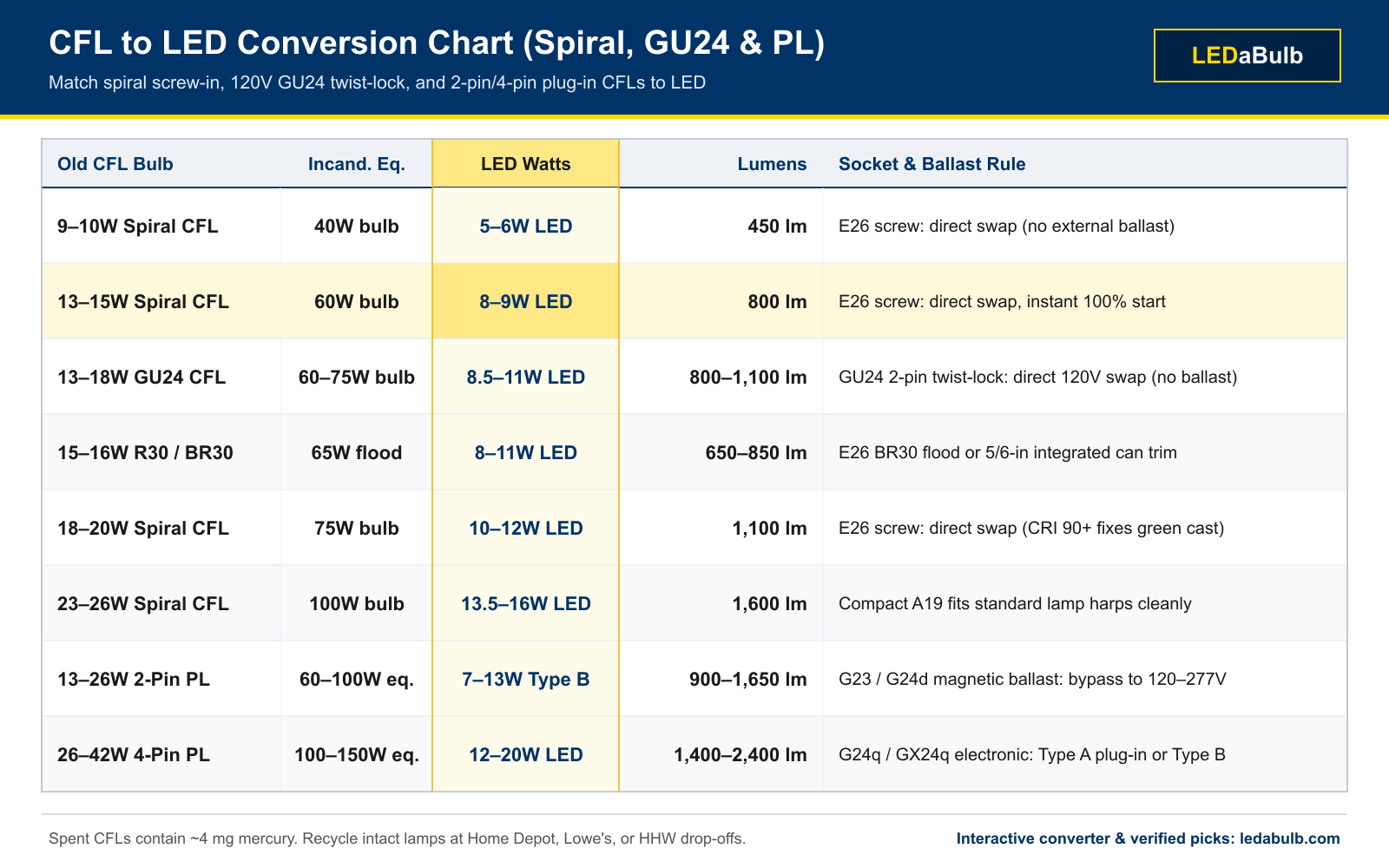
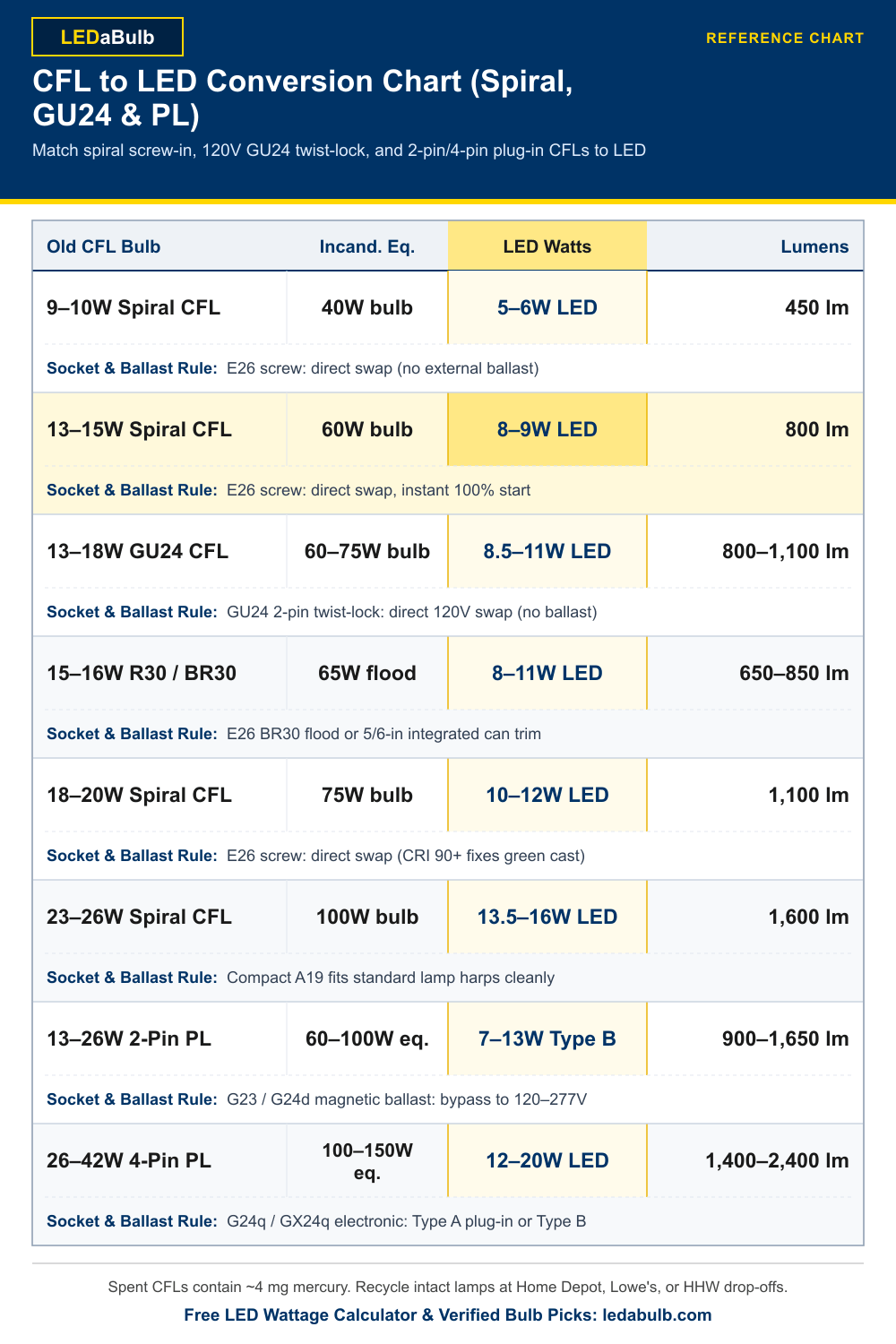
Because CFL boxes used smaller wattages than old household bulbs, the middle column shows the familiar incandescent equivalent alongside exact lumen targets.
| Old CFL | LED Replacement | Lumens (Inc. Eq.) | Action |
|---|---|---|---|
1. Screw-In Spiral, Twist-Lock (GU24) & Recessed Flood CFLsSelf-ballasted 120V bulbs. Unscrew or twist out the old CFL and install the matching LED with zero wiring changes. |
|||
| 5W–7W Spiral CFL (E12 / E26 Chandelier) | 3–4.5W LED | 250–350 lm (=25W) | |
| 9W–10W Spiral CFL (E26 / E12 Sconce) | 5–6W LED | 450 lm (=40W) | |
| 13W–15W Spiral CFL (Standard E26 / GU24) | 8–9W LED | 800 lm (=60W) | |
| 15W–16W BR30 CFL (6-in Recessed Flood) | 8–11W BR30 LED | 650–850 lm (=65W) | |
| 18W–20W Spiral CFL (E26 / GU24) | 10–12W LED | 1,100 lm (=75W) | |
| 23W–25W Spiral CFL (E26 / GU24 Bright) | 13.5–16W LED | 1,600 lm (=100W) | |
| 32W–42W Large Spiral (E26 Garage / Lamp) | 20–25W A21 LED | 2,600 lm (=150W) | |
2. Commercial 2-Pin & 4-Pin Plug-In PL Lamps & Mogul Studio CFLsPin-base lamps (G23, G24d, G24q, GX24q) connect to an external ballast inside the fixture. Verify 2-pin vs. 4-pin and Type A vs. Type B wiring. |
|||
| 9W / 13W 2-Pin PL (G23 / GX23 Sconce / Desk) | 5–7W PL LED | 500–800 lm | |
| 13W / 18W 4-Pin PL (G24q-1 / G24q-2 Can) | 8–11W PL LED | 900–1,100 lm | |
| 26W 2-Pin or 4-Pin PL (G24d-3 / G24q-3 Downlight) | 12–18W PL LED | 1,350–1,750 lm | |
| 32W / 42W 4-Pin PL (GX24q-3 / GX24q-4 Triple) | 18–28W PL LED | 2,100–2,750 lm | |
| 55W–105W Mogul Spiral (E26 / E39 Shop / Studio) | 35–60W Corn LED | 4,000–6,900 lm | |
Identify Your CFL Base in 10 Seconds (Screw vs. GU24 vs. G24 Pins)
Ordering the wrong pin base is the number-one mistake on CFL replacements. Compare the bottom of your old bulb against these four socket families before clicking buy:
| Socket Family | What It Looks Like | Hidden Ballast? | Best Replacement Move |
|---|---|---|---|
| E26 / E12 Screw | Standard threaded metal screw base (1-inch E26 or narrow 0.5-inch E12) | No (ballast was inside the old spiral bulb) | Unscrew and install any matching-lumen E26 or E12 LED bulb directly |
| GU24 Twist-Lock | Two short, fat mushroom-shaped metal pegs spaced 24mm apart; twists 1/8 turn to lock | No (runs straight on 120V household wiring) | Twist in a GU24 A19 LED bulb directly; common in 2008–2016 California and Energy Star homes |
| 2-Pin Plug-In (G23 / G24d) | Two thin straight brass pins flanking a central rectangular plastic key; pulls straight out | Yes (Magnetic) inside the fixture housing | Have an electrician bypass the aging magnetic ballast and install a Type B 120–277V G24 LED |
| 4-Pin Plug-In (G24q / GX24q) | Four thin straight brass pins around a square or hexagonal plastic hub; pulls straight out | Yes (Electronic) inside the ceiling/wall box | Use a 4-Pin Type A Plug-In LED if the ballast works, Type B Bypass if dead, or swap the whole trim to a 6-in LED Downlight |
Best LED Replacements for Every CFL Socket Type
Each pick below matches a specific CFL socket so you get instant full brightness, zero mercury, and verified lumens without socket guesswork.
1. Screw-In Spiral (E26) & Twist-Lock (GU24) Residential Bulbs

GE Lighting Relax HD 60W Equivalent A19 Dimmable LED (Replaces 13W-15W CFL)
Replaces the ubiquitous 13W, 14W, and 15W E26 spiral CFL with instant 100% brightness at the flip of the switch, zero mercury vapor, CRI 90 color accuracy, and smooth wall dimming.
Honest Limitation: For E26 medium screw sockets only; pull your old CFL first to confirm it screws in rather than plugging in with 2 or 4 pins.
Check Price on Amazon → High Output (23W-26W Spiral Swap)
Philips Ultra Definition 100W Equivalent A19 LED (Replaces 23W-26W Spiral CFL)
Compact standard-size A19 bulb that replaces bulky, oversized 23W and 26W E26 spiral CFLs without sticking out past lamp shades or hitting ceiling fan glass globes.
Honest Limitation: Select 5000K Daylight on the listing if your old 23W spiral CFL was used in a garage, laundry room, or basement workbench.
Check Price on Amazon → Best GU24 2-Pin Twist-Lock
Sunco GU24 2-Pin Twist-Lock A19 Dimmable LED Bulbs, 9W 800 lm (4-Pack)
Direct 10-second twist-in replacement for 13W-18W GU24 spiral CFLs installed in 2008-2016 Title 24 and Energy Star homes. GU24 fixtures run on 120V line voltage with no hidden ballast to rewire.
Honest Limitation: Fits 2-pin twist-and-lock GU24 sockets (two short stubby knobs spaced 24mm apart), not push-in G24 commercial pin sockets.
Check Price on Amazon →2. Commercial 2-Pin / 4-Pin G24 PL Lamps & Recessed Can Retrofits
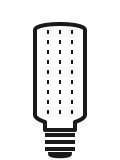
Feit Electric 4-Pin G24q / GX24q Plug-and-Play Type A PL LED Lamp (13W-26W CFL Eq.)
Fastest no-rewiring swap for commercial office cans, hotel corridors, and apartment sconces using 4-pin G24q or GX24q compact fluorescent lamps when the existing electronic ballast still works.
Honest Limitation: Requires a working electronic 4-pin ballast inside the ceiling housing; if the old ballast is dead or 2-pin magnetic (G24d), use a Type B ballast-bypass lamp instead.
Check Price on Amazon → Best 2-Pin / 4-Pin Ballast Bypass (Type B)
Sunco Type B Ballast-Bypass G24d / G24q LED PL Lamp, Rotatable Base (4-Pack)
Permanent fix for buzzing or dead 18W-26W 2-pin (G24d) and 4-pin (G24q) commercial PL fixtures. Eliminates ballast power waste forever, and the rotating base aims all 1,350 lumens straight downward.
Honest Limitation: Never plug a Type B lamp into a live ballast; an electrician must cut out the old CFL ballast and wire 120-277V line power directly to the socket.
Check Price on Amazon → Best Full 5/6-Inch Can Upgrade
Halo RL560 5/6-Inch Selectable-CCT Recessed LED Downlight Retrofit
Best upgrade for recessed ceiling cans running slow-warming R30/BR30 spiral CFLs or yellowed pin-base PL trims. Replaces the bulb and dated baffle at once with CRI 90+, 5-color switchable white light.
Honest Limitation: In commercial 4-pin PL cans (rather than E26 screw cans), disconnect the old ballast and wire the Halo orange quick-connector directly to 120V inside the junction box.
Check Price on Amazon →
CFL vs. LED Performance Comparison
While CFLs cut incandescent wattage by 75% in the 2000s, modern LEDs beat compact fluorescents on every operating spec:
| Specification | Compact Fluorescent (CFL) | Modern LED |
|---|---|---|
| Luminous Efficacy | 50–70 lm/W | 90–130+ lm/W (35%–45% less power) |
| Turn-On Speed | 15–60 seconds (up to 2 min on amalgam BR30 floods) | Instant 100% brightness |
| Short-Cycle Closet Wear | Frequent 2-minute closet switching cuts rated life in half | Unaffected by rapid switching or motion sensors |
| Mercury Content | 1–5 mg toxic mercury vapor per glass tube | 0 mg mercury; shatter-resistant polycarbonate or coated glass |
| Wall Dimming | Most buzz, strobe, or shut off on dimmers | Smooth 5%–100% dimming on LED-rated switches |
| Cold Garage Starting | Dim pink glow or failure below 10°F | Instant start down to -20°F to -40°F |
| Color Accuracy (CRI) | 80–82 typical | 90–95+ widely available |
How to Recycle Old CFL Bulbs Safely
Never throw unbroken or broken CFL spirals and PL tubes into regular household trash, because crushed glass releases mercury vapor in collection trucks and landfills:
- Free retail drop-off bins: Most Home Depot, Lowe's, and Batteries Plus stores keep a free CFL bulb recycling bin right inside the main entrance vestibule. Wrap unbroken bulbs in a small paper bag so the glass tubes do not snap in your car.
- Local household hazardous waste: Search your ZIP code at Earth911.com for municipal mercury-lamp drop-off sites.
- If a CFL breaks indoors: Open a window and leave the room for 10 minutes so mercury vapor disperses, shut off central heating or air conditioning, scoop glass and white phosphor powder using stiff cardboard and sticky duct tape (never vacuum first, which blows mercury vapor into the air), and seal everything inside a glass jar or double plastic bag per EPA cleanup instructions.
Frequently Asked Questions
What LED wattage replaces a 13W or 14W spiral CFL bulb?
An 8W to 9W LED bulb delivering 800 lumens replaces any 13W, 14W, or 15W E26 spiral CFL. Both match the brightness of a traditional 60-watt incandescent bulb, while the LED cuts another 35% to 40% off your power draw and starts instantly.
Can I replace a GU24 2-pin twist-lock CFL with an LED without rewiring?
Yes. Unlike 2-pin push-in commercial G24d sockets, residential GU24 twist-and-lock sockets supply standard 120V household power with no hidden ballast inside the fixture. Simply twist out the old spiral CFL and twist in a GU24 LED bulb.
Can I plug a 4-pin LED directly into my G24q commercial CFL socket?
Only if you buy a Type A (Plug-and-Play) 4-pin LED and the existing electronic ballast inside the ceiling box is still healthy and listed as compatible. If the ballast is buzzing, dead, or uses a 2-pin magnetic G24d base, have an electrician bypass the ballast and wire 120–277V line voltage directly to a Type B G24 LED.
Are CFL bulbs banned in the United States now?
Most screw-base and pin-base CFLs are disappearing rapidly due to two overlapping rules: the federal 45 lm/W minimum efficacy rule (which eliminated lower-efficiency decorative and flood CFLs) and state-level mercury lamp bans already enacted in California, Vermont, Maine, Colorado, Oregon, Hawaii, Rhode Island, Illinois, and Minnesota between 2023 and 2026.
How do I match the exact light color of my old CFL?
Check the four-digit Kelvin code printed near the base of your old CFL: 2700K is warm Soft White (living rooms and bedrooms), 3500K–4100K is Cool White (common on commercial office PL tubes and kitchens), and 5000K–6500K is crisp Daylight (garages and laundry rooms).