Incandescent to LED Conversion Chart & Bulb Buying Guide
As an Amazon Associate, we earn from qualifying purchases. Recommendations never depend on commission rates.
Affiliate Disclosure: When you buy through our links, we may earn a commission at no extra cost to you. That supports our specification database and calculators.
Selection Methodology: Picks come from verified manufacturer data sheets, certification databases (DesignLights Consortium QPL for commercial fixtures, California Title 24 JA8, FTC Lighting Facts, and EPA ENERGY STAR for recessed downlights), and owner failure-rate analysis. We do not run hands-on lab tests.
A traditional incandescent bulb turns roughly 90% of its electricity into heat and only 10% into visible light. Matching your replacement by lumens instead of watts delivers the exact same warm brightness on 85% less power across E26 household lamps, E12 chandeliers, BR30 ceiling cans, and 3-way table lamps.
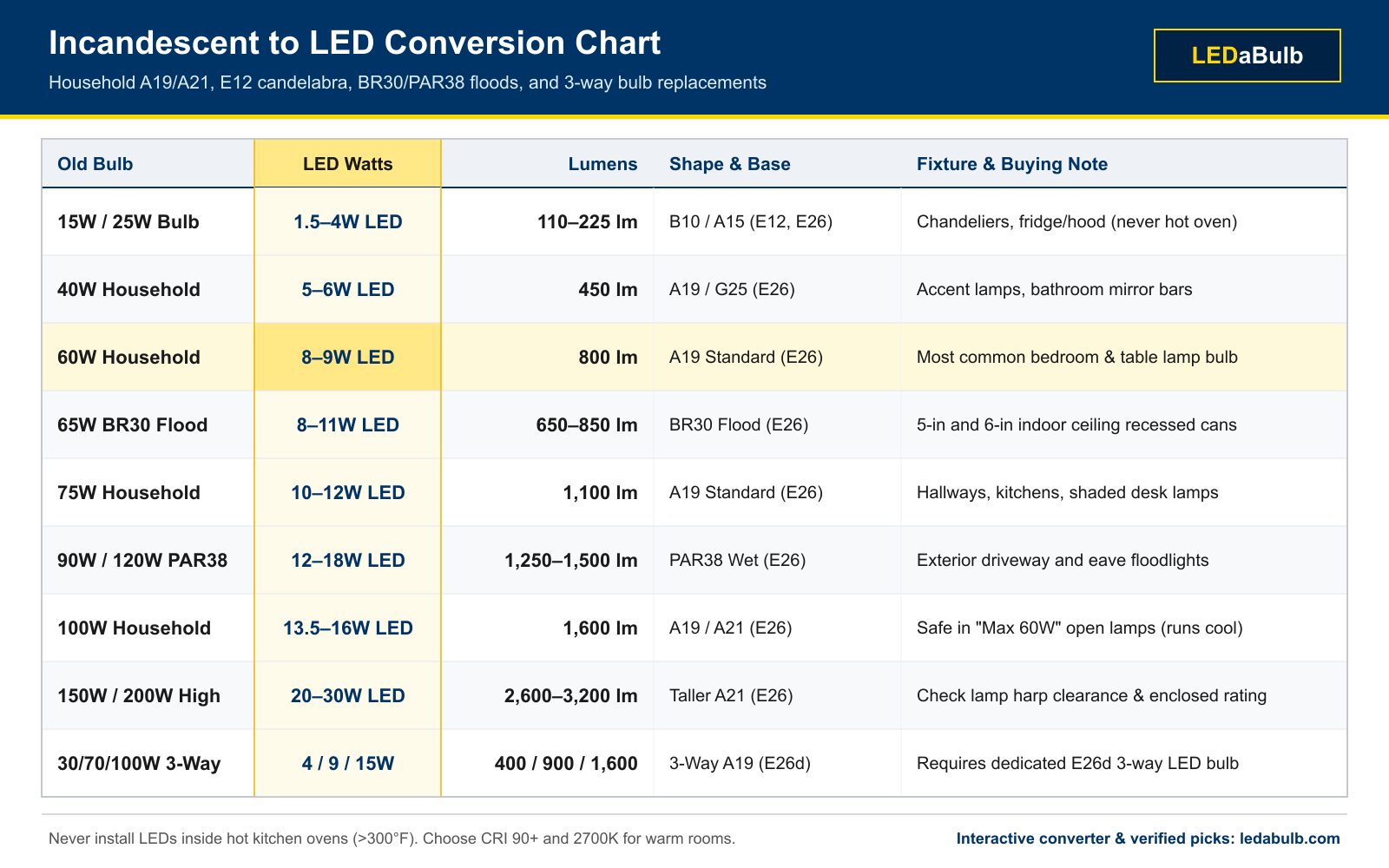
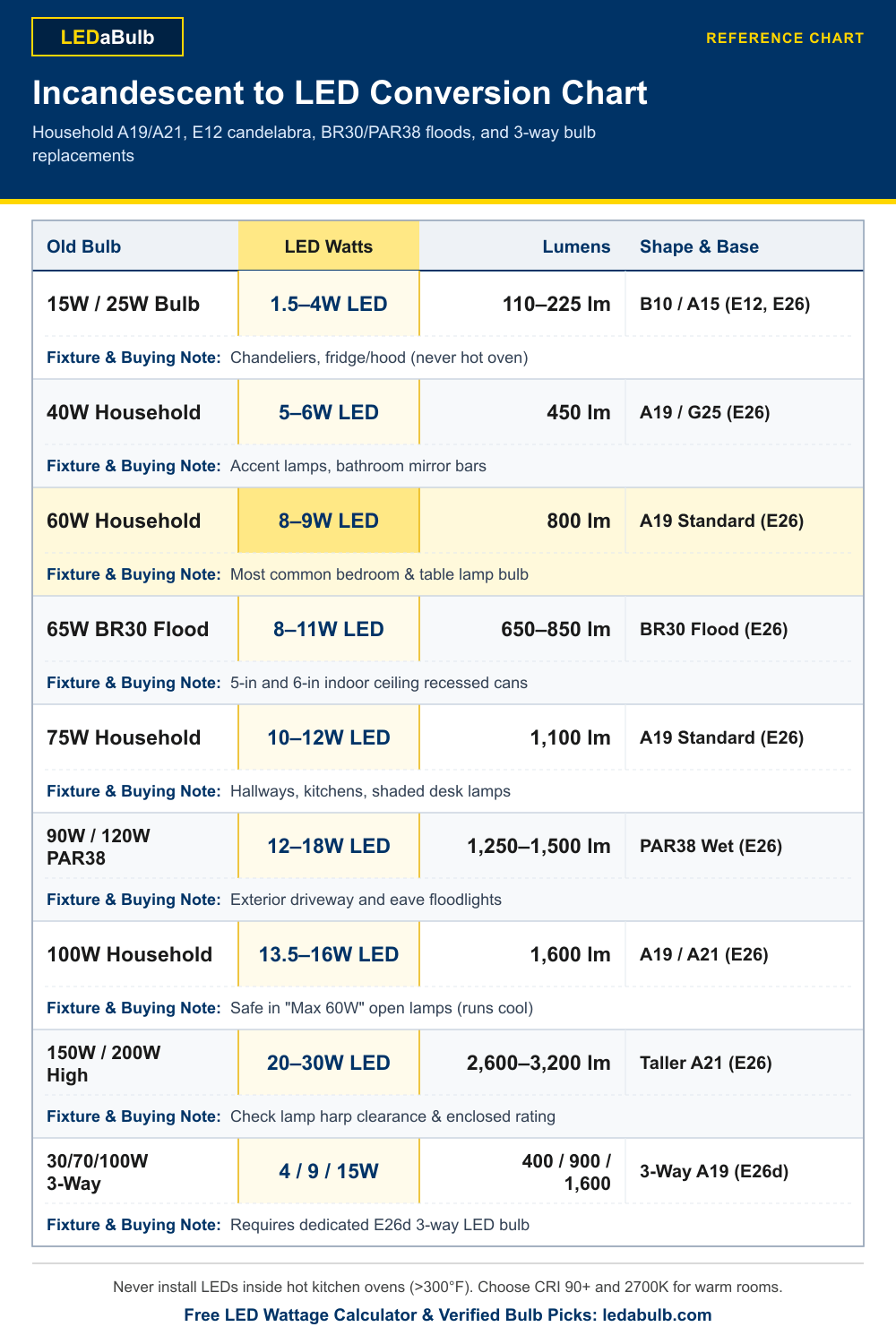
- Fast Lumen Match: 25W (225 lm) → 3–4W LED · 40W (450 lm) → 5–6W LED · 60W (800 lm) → 8–9W LED · 75W (1,100 lm) → 10–12W LED · 100W (1,600 lm) → 14–16W LED · 150W (2,600 lm) → 20–25W LED.
- Best Everyday 60W Replacements (A19 E26): GE Relax HD 60W-Eq A19 (CRI 90) for living rooms and bedrooms, Philips Ultra Definition Warm Glow A19 (CRI 95) if you use wall dimmers, or Sylvania 8-Pack for budget whole-home swaps.
- Specialty Fixtures: Philips 100W-Eq A19 (1,600 lm) for dark reading lamps, GE Relax HD B11 E12 for chandeliers, and Philips BR30 Warm Glow for 6-inch recessed ceiling cans.
- Color Rule: Pick 2700K Soft White and CRI 90+ so your room keeps the exact warm golden tone of incandescent glass rather than harsh blue hospital light.
Quick Household Bulb, Shape & Savings Finder
Choose your old bulb's wattage and where it is installed to verify the exact LED lumen target, bulb shape, socket thread, and fixture heat or dimmer rules before you buy.
Incandescent to LED Conversion Chart (Household, Floods & 3-Way)
Match your old bulb in the left column, then verify the lumens printed on the new LED's Lighting Facts label rather than relying on front-of-box marketing claims alone.
| Old Incandescent | LED Watts | Brightness (Lumens) | Savings | Action |
|---|---|---|---|---|
| 15W Incandescent (A15 Appliance / E12) | 1.5–2W LED | 110 lm | ~87% | |
| 25W Incandescent (B10/B11 E12 Candelabra) | 3–4W LED | 225 lm | ~85% | |
| 40W Incandescent (A19 / G25 / E12) | 5–6W LED | 450 lm | ~86% | |
| 60W Incandescent (Standard A19 E26) | 8–9W LED | 800 lm | ~86% | |
| 65W BR30 Flood (6-in Recessed Can) | 8–11W LED | 650–850 lm | ~85% | |
| 75W Incandescent (A19 E26) | 10–12W LED | 1,100 lm | ~85% | |
| 90W / 120W PAR38 (Outdoor Flood E26) | 12–16W LED | 1,200–1,500 lm | ~86% | |
| 100W Incandescent (A19 / A21 E26) | 13.5–16W LED | 1,600 lm | ~85% | |
| 150W Incandescent (A21 E26) | 20–25W LED | 2,600 lm | ~85% | |
| 200W Incandescent (A21 / PS25 Utility) | 25–30W LED | 3,200 lm | ~86% | |
| 300W Utility (PS30 / Barn / Garage) | 35–45W LED | 4,800–5,000 lm | ~86% | |
| 30/70/100W 3-Way (A19 E26d Table Lamp) | 4 / 9 / 15W LED | 400 / 900 / 1,600 lm | ~85% | |
| 50/100/150W 3-Way (A21 E26d Floor Lamp) | 6 / 14 / 21W LED | 600 / 1,600 / 2,200 lm | ~86% |
Replacing industrial 500W, 750W, 1000W, or 1500W mogul-base stage, yard, or work floodlights? Those fixtures deliver 8,000 to 24,000 lumens and convert best to integrated 65W–200W outdoor LED floodlights or 100W–150W UFO high bays rather than screw-in household bulbs.
Best LED Replacements for Incandescent Bulbs
Cheap off-brand LED multipacks often flicker at 120Hz, turn skin tones washed-out gray (CRI 80), and burn out early in ceiling globes. Every bulb below comes from an established household lighting manufacturer with verified lumen and color specs.
1. Everyday 60W Replacements (Standard A19 E26, 800 Lumens)

Sylvania 60W Equivalent A19 Soft White LED Bulbs (8-Pack)
Low per-socket price from a legacy household brand for whole-home 60W incandescent changeouts. Cuts lamp wattage from 60W to 8.5W while delivering a full 800 lumens of 2700K Soft White light.
Honest Limitation: CRI 80 is fine for hallways, closets, and utility fixtures, while living spaces and kitchens look richer under CRI 90+ bulbs.
Check Price on Amazon → Best Value
GE Lighting Relax HD 60W Equivalent Dimmable A19 LED Bulbs (4-Pack)
Everyday household pick for table lamps, bedrooms, and living rooms. CRI 90 color rendering brings out warm wood, fabric, and skin tones without the flat gray cast of cheap 80-CRI bulbs.
Honest Limitation: Holds a steady 2700K color temperature as you dim it rather than warming down toward 2200K candle tones.
Check Price on Amazon → Premium / Best Dimming
Philips Ultra Definition 60W Equivalent A19 LED with Warm Glow (4-Pack)
Closest visual match to a real incandescent bulb. CRI 95 rendering pairs with Philips Warm Glow dimming, which shifts color from 2700K at full output down to a golden 2200K amber as you dim the switch.
Honest Limitation: Pair with an LED-rated wall dimmer (such as Lutron Diva LED+ or Caseta) for smooth low-end dimming without buzz.
Check Price on Amazon →2. High-Output 100W, Chandelier (E12) & Recessed Can (BR30) Picks
Philips Ultra Definition 100W Equivalent A19 Dimmable LED Bulbs (4-Pack)
Fits a standard A19 lamp harp while delivering 1,600 lumens on just 13.5W. Safe to put inside fixtures stamped 'Max 60W Incandescent' because 13.5W generates a fraction of a 60W bulb's heat.
Honest Limitation: At 1,600 lumens, an unshaded clear bulb is bright enough to cause glare at eye level; choose the frosted envelope inside open lamp harps.
Check Price on Amazon → Best E12 Chandelier & Fan
GE Lighting Relax HD 40W Equivalent B11 E12 Candelabra Dimmable LED (4-Pack)
Replaces hot 25W and 40W E12 flame-tip incandescent bulbs in dining chandeliers, wall sconces, and ceiling fan light kits. Five 4W bulbs draw 20W total instead of 200W.
Honest Limitation: Check whether your chandelier uses small E12 candelabra threads (12mm) rather than standard E26 medium sockets before ordering.
Check Price on Amazon → Best 65W BR30 Ceiling Can
Philips Ultra Definition 65W Equivalent BR30 Flood LED with Warm Glow
Direct screw-in upgrade for 65W BR30 incandescent recessed ceiling floods. Wide 110-degree frosted face fills kitchen and living room ceilings without harsh shadows, using 89% less electricity.
Honest Limitation: Sized for 5-inch and 6-inch recessed ceiling cans; 4-inch cans take smaller R20 bulbs instead.
Check Price on Amazon →
4 Fixture Traps to Check Before Screwing In an LED
Ninety percent of household sockets are a direct 10-second swap, except for these four fixtures where standard A19 LEDs fail or misbehave:
| Fixture Type | What Goes Wrong | Exact Fix |
|---|---|---|
| Hot Kitchen Oven Cavity | Baking temperatures (350°F–500°F+) melt plastic LED domes and destroy the base driver electronics in minutes | Keep a traditional 40W high-temp incandescent/halogen oven bulb inside the oven. Use A15 LED appliance bulbs only in refrigerators, freezers, and range hoods. |
| Sealed Glass Ceiling Domes | Trapped heat cooks standard LED capacitors, causing flicker or failure in 6–12 months | Check the fine print on the box for Suitable for Enclosed Fixtures (such as Philips Ultra Definition or enclosed-rated A19s). |
| 3-Way Table & Floor Lamps | A normal dimmable LED only lights on two clicks of a 3-way rotary socket and stays dark on the third | Buy a dedicated 3-Way LED bulb with an E26d dual-contact brass ring base (4/9/15W), or leave a standard LED on the middle click. |
| Old Rotary Wall Dimmers | Pre-2012 incandescent TRIAC dimmers expect a 40W–60W minimum load, causing 8W LEDs to buzz, strobe, or stay dimly lit | Pair dimmable bulbs with an LED+ wall dimmer (such as Lutron Diva LED+ or Caseta; see our Dimmer Flicker Fix Guide). |
How to Match Warm Incandescent Light Color (Kelvin & CRI)
People who dislike LEDs almost always accidentally bought a 5000K Daylight bulb at 80 CRI for a bedroom or living room. Two specs on the box control whether an LED looks identical to an incandescent filament:
- 2700K Soft White (Warmth): Traditional tungsten filaments glow at 2700K. Choose 2700K for bedrooms, living rooms, dining rooms, and shaded lamps. Choose 3000K Warm White for kitchens and bathrooms, and reserve 4000K–5000K strictly for garages, basements, and workbenches.
- Dim-to-Warm (2700K down to 2200K): Real incandescent filaments turn deeper amber as you dim them, while standard LEDs just get dimmer at the same 2700K white. Philips Warm Glow bulbs replicate that amber shift automatically on any compatible dimmer.
- CRI 90+ (Color Rendering Index): Incandescent light has a natural CRI of 100. Choosing CRI 90 or 95 ensures redbrick, oak floors, food, and skin tones look rich rather than muted.
Running Household Lamps During a Power Outage
Replacing 60W incandescent bulbs with 8.5W LEDs multiplies backup battery runtime by seven during a storm outage. A 500 Wh portable power station (about 425 Wh usable AC output after inverter loss) runs one 60W incandescent lamp for roughly 7 hours. Swap in 8.5W LEDs and that same 500 Wh battery runs a single lamp for 50 hours, or lights five rooms at once (42.5W total) for 10 hours while leaving capacity for a Wi-Fi router and phone charging. If you are sizing a battery backup or solar generator for home outages, compare verified watt-hour specs and price per Wh on Power Portable.
Frequently Asked Questions
Can I put a 100W-equivalent (14W) LED in a lamp stamped "Max 60W"?
Yes, in almost every open lamp. The "Max 60W" sticker is a thermal fire limit for hot 60W incandescent bulbs, not a brightness cap. A 14W LED draws 77% less electricity and runs far cooler than a 60W incandescent while giving you 1,600 lumens of reading light. Just stay under any separate "Max LED Watts" label if the fixture has one, and confirm enclosed-fixture rating inside sealed globes.
Are incandescent light bulbs completely banned in the United States?
General-service incandescent bulbs (standard 40W, 60W, 75W, and 100W household lamps) were phased out in August 2023 under the U.S. Department of Energy's 45 lumens-per-watt minimum efficiency rule, because tungsten filaments only reach 10 to 15 lm/W. Specialty oven bulbs, appliance lamps, bug lights, and certain rough-service bulbs remain exempt.
Can I use an LED bulb in my kitchen oven or microwave?
Never install an LED bulb inside a conventional oven, toaster oven, or broiler cavity, where heat above 300°F melts plastic lenses and ruins the internal LED driver. LEDs work safely in refrigerators, freezers, and range hoods above the stove (use a damp-rated glass A15 or PAR20 bulb over boiling pots).
What if I want the exposed vintage Edison filament look?
Look for clear glass LED filament bulbs in shapes A19, ST19 (teardrop), or G25 (globe) at 2200K to 2700K. Thin yellow sapphire-substrate LED strips mimic glowing tungsten wires in all directions while drawing only 4.5W to 7W.
How much money does switching a whole house from incandescent to LED save?
Replacing one 60W incandescent bulb with an 8.5W LED used 3 hours per day at the $0.18/kWh U.S. residential average saves $10.15 per year. Across 25 frequently used household sockets, switching saves roughly $250 per year plus fewer summer air-conditioning watts.